
Getting your website on Google is important, but getting the right people to visit it is even more important. On-page SEO services help improve your website pages so search engines can better understand your content and users can easily find the information they need.
A properly optimized website can have better visibility, improved user experience, and stronger opportunities to attract organic traffic. For businesses, blogs, and brands, professional on-page SEO can provide a strong foundation for long-term SEO growth.
At ContentAIStudio, we provide practical SEO solutions that help websites improve their content, structure, and search visibility.
What Is On-Page SEO?
On-page SEO is the process of optimizing elements on your website to help search engines understand and rank your pages.
It includes both content and technical elements that are visible or directly related to individual web pages.
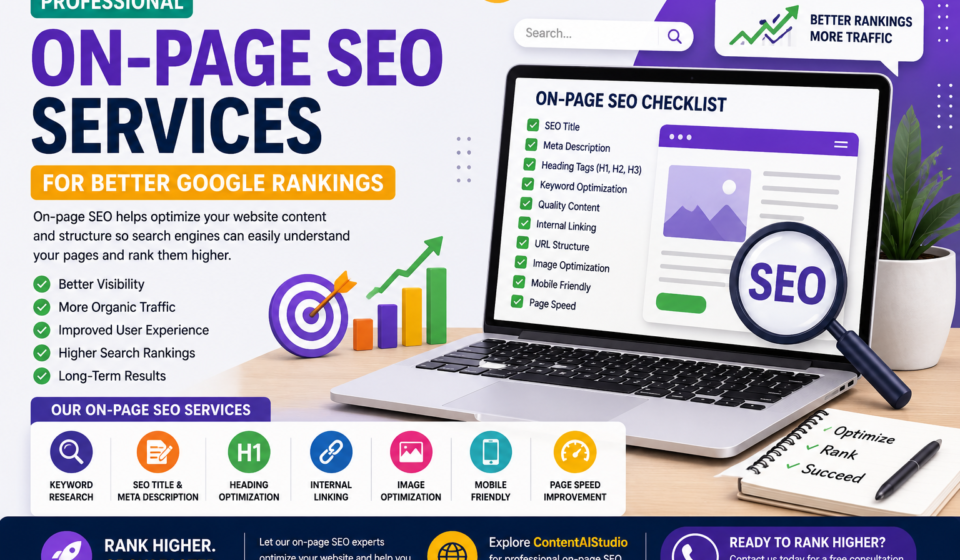
Important on-page SEO elements include:
- SEO title
- Meta description
- Headings
- Keywords
- Website content
- Internal links
- URL structure
- Images and alt text
- Content readability
- Search intent
- Mobile-friendly design
The main goal is to make your pages useful for visitors and easier for search engines to understand.
Why On-Page SEO Is Important
A website may have great products or services, but poor optimization can make it difficult for people to find those pages through Google.
Professional on-page SEO services can help you:
- Improve website visibility
- Target relevant keywords
- Increase organic traffic
- Improve page structure
- Make content easier to read
- Help search engines understand your pages
- Improve user experience
- Support better Google rankings
On-page SEO also helps create a clear connection between what people search for and what your website offers.
Our Professional On-Page SEO Services
Every website has different SEO needs. We review your pages and optimize important elements according to your business, audience, and target keywords.
1. SEO Keyword Research
Keyword research is one of the first steps in on-page SEO.
We identify keywords that your potential customers may use when searching for your products, services, or information.
Keyword research can include:
- Primary keywords
- Secondary keywords
- Long-tail keywords
- Location-based keywords
- Informational keywords
- Commercial keywords
For example, instead of targeting only “SEO services,” a business may also target more specific terms such as “on-page SEO services for small businesses.”
Using relevant keywords helps attract visitors who are more likely to be interested in your website.
2. SEO Title Optimization
The SEO title tells users and search engines what a page is about.
A good title should:
- Clearly describe the page
- Include the main keyword naturally
- Be relevant to search intent
- Encourage users to click
- Avoid unnecessary words
For example:
Poor Title:
Home Page
Better Title:
Professional SEO Services for Businesses | ContentAIStudio
A clear title gives both Google and users a better idea of what they can expect from the page.
3. Meta Description Optimization
A meta description provides a short summary of a webpage.
Although it is not the only factor involved in search performance, a clear meta description can encourage users to click on your result.
A good meta description should:
- Explain the page
- Use the target keyword naturally
- Match the page content
- Give users a reason to visit
Each important page should have a useful and relevant meta description.
4. Heading Optimization
Headings help organize your content.
A properly structured page may use:
- H1 for the main page title
- H2 for major sections
- H3 for supporting sections
For example:
H1: Professional On-Page SEO Services
H2: What Is On-Page SEO?
H2: Benefits of On-Page SEO
H3: Keyword Optimization
This structure makes long content easier to read and understand.
5. Keyword Optimization
Keywords should be used naturally throughout your content.
We focus on placing relevant keywords in areas such as:
- Page title
- Main heading
- Introduction
- Subheadings
- Body content
- Image alt text
- URL where appropriate
- Meta description
The goal is not to repeat the same keyword again and again. Keyword stuffing can make content difficult to read and may create a poor user experience.
Natural and useful content is always the better approach.
6. Search Intent Optimization
Search intent means understanding what a person wants when they type a query into Google.
For example, someone searching for “best WordPress plugins” may want information and recommendations.
Someone searching for “WordPress website development services” may be looking for a service provider.
Understanding search intent helps us create content that matches what users are actually looking for.
7. Content Optimization
Good SEO content should provide useful information instead of simply adding keywords to a page.
We can improve existing content by:
- Adding missing information
- Removing unnecessary sections
- Improving headings
- Making sentences clearer
- Adding relevant keywords
- Improving readability
- Updating outdated information
- Answering common customer questions
Content should be written for real people first and optimized for search engines in a natural way.
8. Internal Linking
Internal links connect one page of your website to another page on the same website.
For example, a blog about SEO can link to your SEO services page.
Internal linking can help:
- Visitors discover related content
- Search engines understand website structure
- Important pages receive more internal attention
- Users move easily between related topics
A good internal linking strategy should use relevant and natural anchor text.
9. URL Optimization
A clean URL is easier for users to understand.
For example:
example.com/on-page-seo-services
is clearer than:
example.com/page?id=12345
SEO-friendly URLs should be:
- Short
- Descriptive
- Relevant
- Easy to read
- Free from unnecessary characters
The main topic or keyword can be included when it makes sense.
10. Image SEO
Images can improve the appearance and usefulness of your website. However, they also need proper optimization.
Image SEO can include:
- Descriptive file names
- Relevant alt text
- Image compression
- Proper image sizes
- Suitable formats
For example, instead of naming an image:
IMG12345.jpg
a more descriptive name could be:
on-page-seo-services.jpg
This gives more useful context about the image.
11. Content Readability
Visitors should be able to understand your website without difficulty.
We focus on:
- Short paragraphs
- Clear headings
- Simple words
- Useful bullet points
- Easy sentence structure
- Natural transitions
This is especially important for business websites that want to reach a wide audience.
Clear content can help visitors quickly find the information they need.
12. Mobile-Friendly On-Page SEO
Many people use smartphones to browse websites. Your pages should work properly on smaller screens.
A mobile-friendly page should have:
- Readable text
- Easy navigation
- Properly sized images
- Buttons that are easy to tap
- Responsive layouts
- Fast-loading elements
A good mobile experience helps visitors use your website more comfortably.
Benefits of Professional On-Page SEO Services
Better Website Visibility
Optimized pages can help search engines understand the topics and services covered on your website.
This can create more opportunities for your pages to appear for relevant searches.
More Relevant Organic Traffic
Good keyword and search intent research helps attract people who are actually interested in your content, products, or services.
This is more useful than simply trying to increase visitor numbers.
Improved User Experience
On-page SEO is not only about Google. It also improves the experience of your website visitors.
Clear content, useful headings, simple navigation, and fast pages make it easier for users to explore your website.
Stronger Website Structure
Internal links, organized headings, clean URLs, and optimized pages create a better website structure.
This makes it easier for users and search engines to understand your website.
Better Opportunities for Leads
When your pages appear for relevant searches, more potential customers can discover your business.
A clear call to action can then encourage visitors to:
- Contact you
- Request a quote
- Buy a product
- Book a service
- Subscribe to your newsletter
On-Page SEO for Small Businesses
Small businesses can benefit greatly from focused on-page SEO.
Instead of trying to rank for every popular keyword, a small business can focus on keywords related to its services, products, and location.
For example, a local web development business may target:
- WordPress website development
- WordPress website development services
- Website development for small businesses
- WordPress developer in Pakistan
Specific keywords can help businesses reach a more relevant audience.
On-Page SEO for Blogs
Blogs can attract visitors by answering questions and providing useful information.
For SEO-friendly blog posts, we focus on:
- Search intent
- Keyword research
- Useful headings
- Original information
- Internal links
- FAQs
- Readability
- Meta title
- Meta description
A well-optimized blog can also support other pages on your website through internal links.
Common On-Page SEO Mistakes
Many websites make simple SEO mistakes that can affect their performance.
Common problems include:
- Using the same title on multiple pages
- Missing meta descriptions
- Keyword stuffing
- Poor heading structure
- Very long paragraphs
- Weak internal linking
- Duplicate content
- Unclear URLs
- Missing image alt text
- Ignoring mobile users
- Writing without search intent
Fixing these problems can create a stronger foundation for your SEO strategy.
Our On-Page SEO Process
We use a simple process to keep SEO work organized.
Step 1: Website Review
We check your website pages and identify important on-page SEO issues.
Step 2: Keyword Research
We research relevant keywords based on your business and target audience.
Step 3: Content Review
We review existing content and identify areas that need improvement.
Step 4: Page Optimization
We optimize titles, headings, content, URLs, images, links, and other important elements.
Step 5: Internal Linking
We connect relevant pages to improve navigation and website structure.
Step 6: Final SEO Check
We review the optimized pages to make sure important SEO elements are properly covered.
Why Choose ContentAIStudio?
At ContentAIStudio, we focus on creating simple and practical SEO solutions for websites, blogs, businesses, and brands.
Our SEO services can include:
- On-page SEO
- Technical SEO
- Keyword research
- SEO content writing
- Blog optimization
- Website SEO audits
- Internal linking
- WordPress SEO
We focus on useful content, clean website structure, and SEO practices that support long-term growth.
Conclusion
Professional on-page SEO services can help businesses, blogs, and brands build a stronger foundation for organic search visibility. From keyword research and content optimization to SEO titles, headings, internal links, URLs, and image optimization, each element plays a useful role.
A successful on-page SEO strategy should focus on both search engines and people. When your pages provide clear, useful, and relevant information, visitors can find what they need more easily.
Frequently Asked Questions
What are on-page SEO services?
On-page SEO services involve optimizing individual website pages to improve their content, structure, relevance, and search engine visibility.
Can on-page SEO improve Google rankings?
On-page SEO can help search engines better understand your pages and their relevance to search queries. However, rankings depend on many factors, including competition, website quality, content, and overall SEO.
How long does on-page SEO take?
The time depends on the size of the website and the amount of work required. Small websites may need less time, while large websites with many pages require a more detailed process.
Is keyword research part of on-page SEO?
Yes. Keyword research helps identify relevant search terms and provides direction for page titles, headings, content, and other SEO elements.
Is on-page SEO useful for WordPress websites?
Yes. WordPress websites can benefit from optimized titles, content, headings, images, URLs, internal links, and other on-page elements.
Do old blog posts need on-page SEO?
Yes. Existing blog posts can often be improved by updating information, adding relevant keywords, improving headings, adding internal links, and making the content easier to read.
Looking for professional on-page SEO services to improve your website visibility and attract more organic traffic? Explore ContentAIStudio and discover practical SEO solutions designed for websites, blogs, and businesses.
Want to learn more about improving your website’s overall SEO? Read our guide on Expert Digital Marketing Services for Businesses and Brands for simple tips and practical strategies.